LeBlanc.ca
Welcome
Welcome
-Olney Trainer LeBlanc-
Aug 1903 - Jan 1963
Aug 1903 - Jan 1963
Olney Trainer LeBlanc’s life, a strict Catholic upbringing, Marine Corps service in Haiti and the homicide he committed in 1942, forms a striking pattern of instability, repeated loss, and emotional upheaval. When viewed as a whole, his story reflects a man who endured a series of shocks and transitions without the support or understanding that would be available today.
His early life was marked by disruption and strict structure in equal measure. His mother Alma, née Bernard, died on 9 January 1914, depriving him of maternal stability during childhood. A couple of years afterward, his father remarried significantly, to a woman who bore the same surname as his late wife. Whether coincidence or an extended family connection, the remarriage altered the household structure at a formative time and introduced an additional layer of complexity to his upbringing.
Olney’s father, Desma, was a staunch member of the Catholic Church and a Fourth Degree Knight of Columbus. He raised his children in a disciplined and strictly religious household, one that likely emphasized duty, moral conduct, obedience, and emotional restraint.
At just fifteen years of age, in June of 1918, Olney enlisted in the U.S. Marine Corps—an extraordinary step for someone so young. Whether driven by patriotism, a desire for independence, family dynamics, or the broader atmosphere of wartime America, the decision placed him immediately into an adult world defined by hierarchy and discipline. His first period of service was brief, the war coming to end in the same year he enlisted; he was discharged in December 1919 and returned to civilian life while still in his mid-teens. For approximately a year he worked various odd jobs, including employment at a refinery in Texas while living with an Uncle. The transition from military structure to uncertain civilian labor at such a young age likely brought instability of its own.
In December 1920, he re-enlisted in the Marine Corps and was immediatley assigned a post in Haiti during the American occupation, a deployment known for extreme American atrocities, harsh conditions, tropical disease, and psychological strain. Marines stationed in Cap Haïtien in the 1920's frequently suffered from malaria, typhoid, dysentery, heat exhaustion, and other debilitating illnesses. In LeBlanc’s case, service records show that he was repeatedly listed as sick or infirm, sometimes for weeks at a time throughout his deployment. His final two months in the Marines were recorded entirely as periods of illness, a factor that likely contributed significantly to his eventual discharge. Prolonged bouts of tropical disease, recurring fever, dehydration, and physical debilitation were not uncommon in Haiti, but they could leave lasting effects. Modern research suggests that severe infections, extended inflammation, and heat-related stress can have long-term consequences for mood regulation, cognition, and emotional resilience. Even apart from illness, the strain of occupation duty—long patrols, isolation, rigid discipline, and exposure to violence—left many young Marines carrying invisible burdens.
LeBlanc left military service in early 1923, still a young man, but stability continued to elude him. His first marriage to Mildred Civello ended in tragedy when his wife died in October, only two months after the wedding. Such an early and sudden loss can be profoundly destabilizing, especially for someone already shaped by early maternal loss, a strict religious upbringing, repeated transitions between military and civilian life, and prolonged illness. Soon after in April 1926, he remarried a woman who shared the same first name as his deceased wife, Mildred Rutherford—a choice that often reflects unresolved grief or an attempt, conscious or not, to recreate what was lost.
His personal life continued to shift. Since his honorable discharge from the US Marines, he would have married a total of four times within 5 years (Mildred 1925, Mildred 1926, Mattie 1927 & Annette in 1930) suggesting a pattern of emotional turbulence, impulsivity, or difficulty maintaining long-term relationships. His occupations also changed dramatically: at different points he worked as a ballroom dance instructor and a woodworker, two professions that require very different skills and identities. Such occupational swings often indicate a person searching for direction or stability, or someone repeatedly reinventing himself after setbacks.
Another major blow came with the sudden death of his father in December 1927 after a brief illness. Sudden parental loss can reopen earlier wounds and deepen existing emotional vulnerabilities. For someone already carrying grief, instability, prolonged illness during military service, and the psychological weight of a strict religious upbringing, this kind of loss can be especially disruptive.
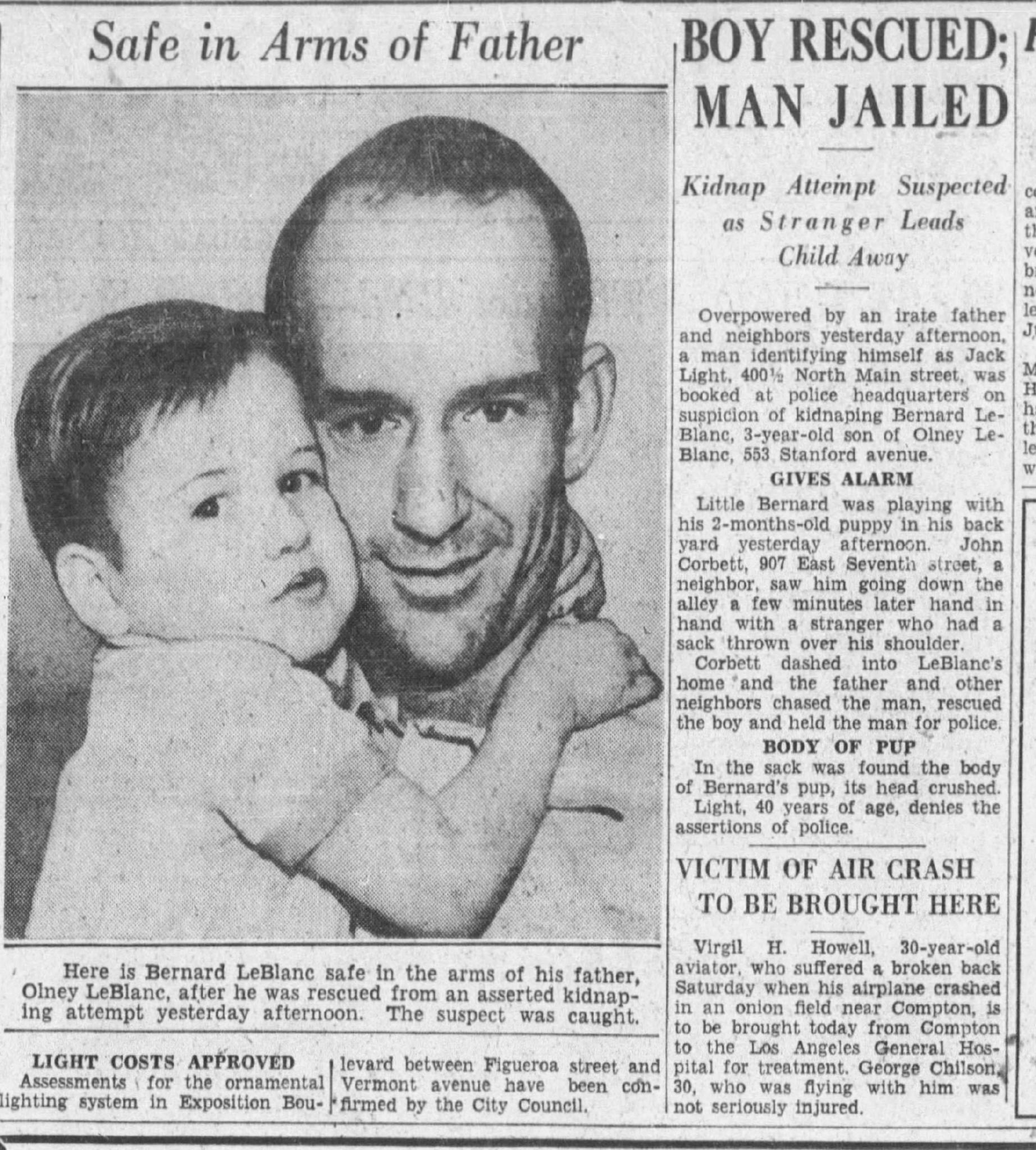
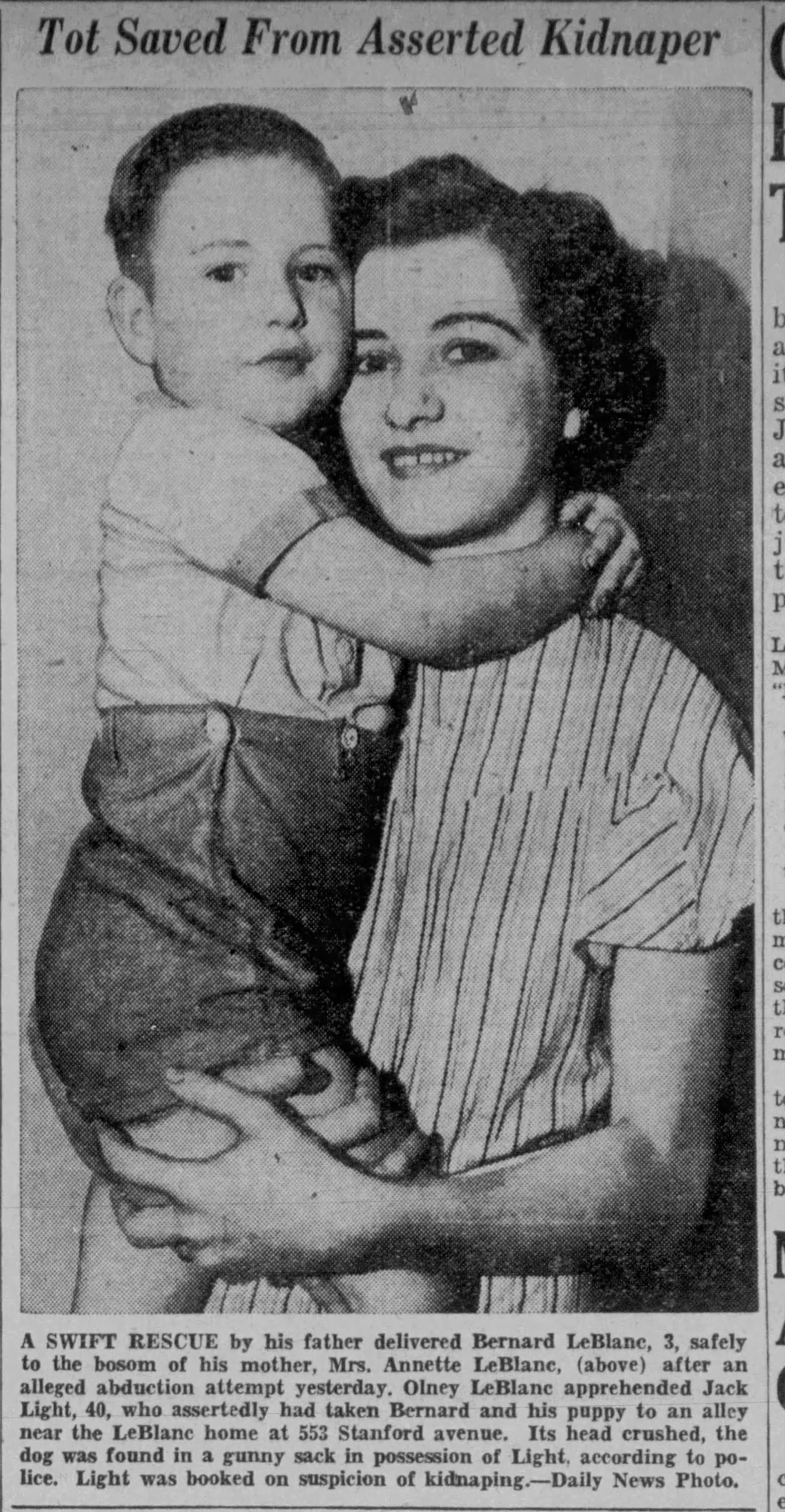
However, in 1935, one episode cast him in a dramatically different light. When his 3 year old son Bernard was abducted, Olney acted decisively and successfully rescued him. The incident portrayed him publicly as a protective and determined father—capable of courage and clear action under pressure. This moment stands in stark contrast to the darker chapter that would follow years later, underscoring the complexity of his character and the contradictions within his life.
After committing the homicide that would define the final chapter of his life, LeBlanc attempted to take his own life but was unsuccessful. The act suggested a state of acute emotional collapse in the immediate aftermath of the crime—whether driven by remorse, despair, fear of consequences, or psychological breakdown. It marked a violent turning inward after years of outward instability and turmoil.
By 1942, apparently seperated from his fouth wife and after having been convicted of murdering a mother of 3, June Dyer, he was photographed at San Quentin following his conviction, observers noting that his mug shot shows a faint, almost ambiguous smile. Whether it reflected defiance, resignation, emotional detachment, or even a sense of relief that the long unraveling of his life had reached a final chapter is impossible to know. What it does suggest is a man no longer visibly fighting circumstances, but instead appearing settled into them.
By the time LeBlanc reached that moment in his life, it had been irreparably scared by repeated upheaval in an era of world wars and economic depression: childhood maternal loss, a restructured and disciplined religious household, enlistment in the Marines at fifteen, an early discharge and year of uncertain civilian labor, re-enlistment and prolonged illness during occupation service in Haiti, the traumatic death of a spouse, multiple marriages, shifting occupations, the rescue of his abducted son, the sudden loss of a parent and finally, the act of suicide. None of these events truly explain or excuse the homicide he ultimately committed, but together they form a picture of a man whose emotional and physical foundation had been shaken many times over. His life reflects the cumulative weight of unresolved trauma, instability, and loss in an era when men had little access to mental health support and few socially acceptable ways to express vulnerability.
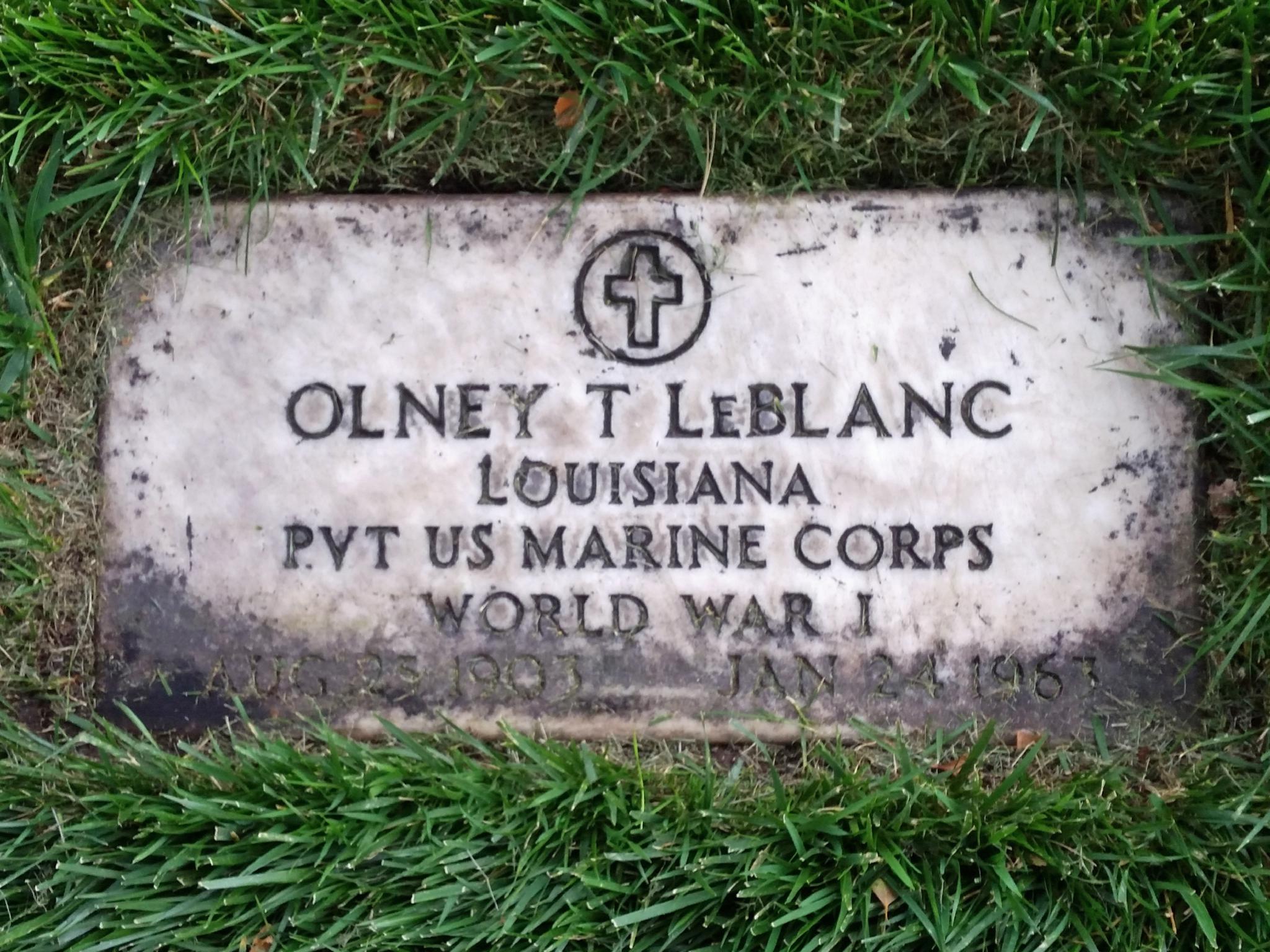
Two decades later, the paper trail closes with bureaucratic clarity. On January 24, 1963, Olney Trainer LeBlanc died in Los Angeles County and was buried at Los Angeles National Cemetery, Plot 190, 22/RY. The juxtaposition is bracing: a man whom California judged worthy of a life sentence rests under the austere grace of a veteran’s headstone, his name and dates aligned among the white stones. Whether he died in custody or after a parole or commutation, the cemetery ledger does not say; it testifies, instead, to a nation obligated to honor military service even when the civilian life that followed turned disastrous.
His early life was marked by disruption and strict structure in equal measure. His mother Alma, née Bernard, died on 9 January 1914, depriving him of maternal stability during childhood. A couple of years afterward, his father remarried significantly, to a woman who bore the same surname as his late wife. Whether coincidence or an extended family connection, the remarriage altered the household structure at a formative time and introduced an additional layer of complexity to his upbringing.
Olney’s father, Desma, was a staunch member of the Catholic Church and a Fourth Degree Knight of Columbus. He raised his children in a disciplined and strictly religious household, one that likely emphasized duty, moral conduct, obedience, and emotional restraint.
At just fifteen years of age, in June of 1918, Olney enlisted in the U.S. Marine Corps—an extraordinary step for someone so young. Whether driven by patriotism, a desire for independence, family dynamics, or the broader atmosphere of wartime America, the decision placed him immediately into an adult world defined by hierarchy and discipline. His first period of service was brief, the war coming to end in the same year he enlisted; he was discharged in December 1919 and returned to civilian life while still in his mid-teens. For approximately a year he worked various odd jobs, including employment at a refinery in Texas while living with an Uncle. The transition from military structure to uncertain civilian labor at such a young age likely brought instability of its own.
In December 1920, he re-enlisted in the Marine Corps and was immediatley assigned a post in Haiti during the American occupation, a deployment known for extreme American atrocities, harsh conditions, tropical disease, and psychological strain. Marines stationed in Cap Haïtien in the 1920's frequently suffered from malaria, typhoid, dysentery, heat exhaustion, and other debilitating illnesses. In LeBlanc’s case, service records show that he was repeatedly listed as sick or infirm, sometimes for weeks at a time throughout his deployment. His final two months in the Marines were recorded entirely as periods of illness, a factor that likely contributed significantly to his eventual discharge. Prolonged bouts of tropical disease, recurring fever, dehydration, and physical debilitation were not uncommon in Haiti, but they could leave lasting effects. Modern research suggests that severe infections, extended inflammation, and heat-related stress can have long-term consequences for mood regulation, cognition, and emotional resilience. Even apart from illness, the strain of occupation duty—long patrols, isolation, rigid discipline, and exposure to violence—left many young Marines carrying invisible burdens.
LeBlanc left military service in early 1923, still a young man, but stability continued to elude him. His first marriage to Mildred Civello ended in tragedy when his wife died in October, only two months after the wedding. Such an early and sudden loss can be profoundly destabilizing, especially for someone already shaped by early maternal loss, a strict religious upbringing, repeated transitions between military and civilian life, and prolonged illness. Soon after in April 1926, he remarried a woman who shared the same first name as his deceased wife, Mildred Rutherford—a choice that often reflects unresolved grief or an attempt, conscious or not, to recreate what was lost.
His personal life continued to shift. Since his honorable discharge from the US Marines, he would have married a total of four times within 5 years (Mildred 1925, Mildred 1926, Mattie 1927 & Annette in 1930) suggesting a pattern of emotional turbulence, impulsivity, or difficulty maintaining long-term relationships. His occupations also changed dramatically: at different points he worked as a ballroom dance instructor and a woodworker, two professions that require very different skills and identities. Such occupational swings often indicate a person searching for direction or stability, or someone repeatedly reinventing himself after setbacks.
Another major blow came with the sudden death of his father in December 1927 after a brief illness. Sudden parental loss can reopen earlier wounds and deepen existing emotional vulnerabilities. For someone already carrying grief, instability, prolonged illness during military service, and the psychological weight of a strict religious upbringing, this kind of loss can be especially disruptive.
However, in 1935, one episode cast him in a dramatically different light. When his 3 year old son Bernard was abducted, Olney acted decisively and successfully rescued him. The incident portrayed him publicly as a protective and determined father—capable of courage and clear action under pressure. This moment stands in stark contrast to the darker chapter that would follow years later, underscoring the complexity of his character and the contradictions within his life.
After committing the homicide that would define the final chapter of his life, LeBlanc attempted to take his own life but was unsuccessful. The act suggested a state of acute emotional collapse in the immediate aftermath of the crime—whether driven by remorse, despair, fear of consequences, or psychological breakdown. It marked a violent turning inward after years of outward instability and turmoil.
By 1942, apparently seperated from his fouth wife and after having been convicted of murdering a mother of 3, June Dyer, he was photographed at San Quentin following his conviction, observers noting that his mug shot shows a faint, almost ambiguous smile. Whether it reflected defiance, resignation, emotional detachment, or even a sense of relief that the long unraveling of his life had reached a final chapter is impossible to know. What it does suggest is a man no longer visibly fighting circumstances, but instead appearing settled into them.
By the time LeBlanc reached that moment in his life, it had been irreparably scared by repeated upheaval in an era of world wars and economic depression: childhood maternal loss, a restructured and disciplined religious household, enlistment in the Marines at fifteen, an early discharge and year of uncertain civilian labor, re-enlistment and prolonged illness during occupation service in Haiti, the traumatic death of a spouse, multiple marriages, shifting occupations, the rescue of his abducted son, the sudden loss of a parent and finally, the act of suicide. None of these events truly explain or excuse the homicide he ultimately committed, but together they form a picture of a man whose emotional and physical foundation had been shaken many times over. His life reflects the cumulative weight of unresolved trauma, instability, and loss in an era when men had little access to mental health support and few socially acceptable ways to express vulnerability.
Two decades later, the paper trail closes with bureaucratic clarity. On January 24, 1963, Olney Trainer LeBlanc died in Los Angeles County and was buried at Los Angeles National Cemetery, Plot 190, 22/RY. The juxtaposition is bracing: a man whom California judged worthy of a life sentence rests under the austere grace of a veteran’s headstone, his name and dates aligned among the white stones. Whether he died in custody or after a parole or commutation, the cemetery ledger does not say; it testifies, instead, to a nation obligated to honor military service even when the civilian life that followed turned disastrous.









Contact

Address
Ottawa, Ontario
The Capital City of Canada
Ottawa, Ontario
The Capital City of Canada
Social Media
- We are not out there yet